
Classroom Cage
Leah’s school refusal was actually a hidden form of claustrophobia
The first time I saw Leah (9) she was clinging to the doorframe with her mother trying to pull her into my practice.
She had refused school for 2 months. Nobody knew what to do anymore.
Finally in, she completely refused to speak with me. She just sat there motionless and ignored me.
The only thing I got her to do was scribble on a piece of paper that she didn’t want to be here with me.
That doesn’t deter me. Been there, done that. There is always a way to break through to a child.
In her case I eventually found it. The key was a boy she liked. I asked her whether he would think it was cool that she was afraid of school and wasn’t showing up. That softened her up a bit. She said no.
Our second session began completely differently. She arrived and said:
“I am ready. Let’s work.”
I hadn’t forced her to do anything. She felt the respect and genuine interest I had in her.
I had her visualize herself walking to school. As she got closer, her fear intensified. She said it was a black shadow in her left thigh. Her breathing quickened. Noise, children everywhere, narrow corridors. The classroom door closing behind her. Now she could barely breathe.
Everyone had been treating school refusal. Nobody found the real cause. This was a form of claustrophobia. In the crowded corridors and closed classroom, surrounded by all those stimuli, Leah felt physically trapped. The school wasn’t the problem. The walls were the problem.
I had her visualize pushing the walls further apart.
We also visualized turning down dials for her sensitivity to noise and movement.
And I had her experience a strong feeling of being loved.
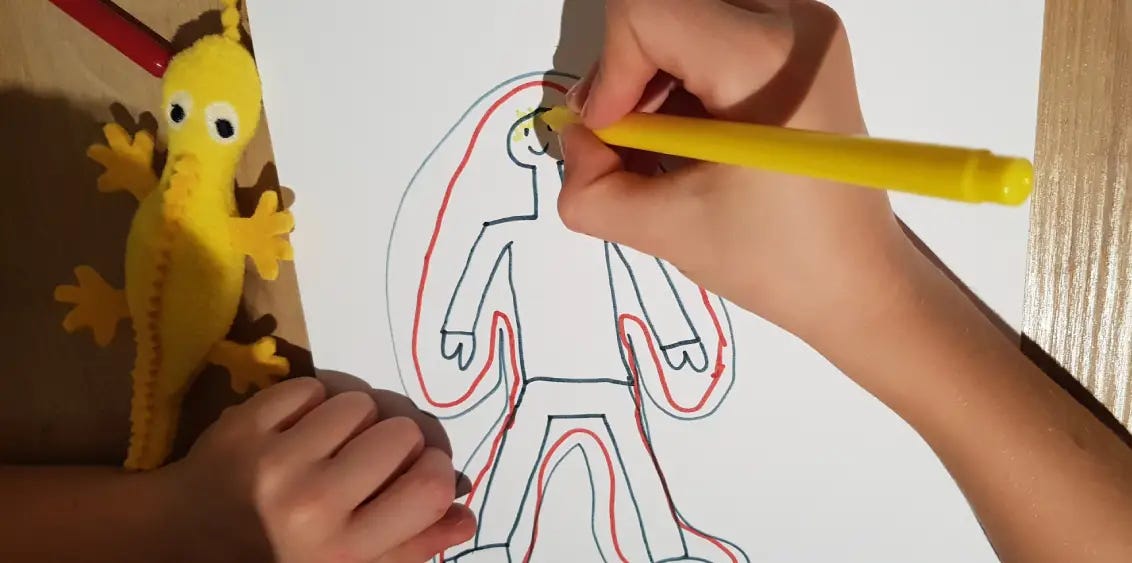
What sounds like a childish gimmick was in reality a direct intervention in Leah’s nervous system.
The Walls: To Leah’s nervous system, walls ten feet away felt like they were pressing against her skin. By “pushing” them back in her mind, she reset her internal sensors and told her brain to stop reporting a collision.
The Dials: Leah was suffering from sensory flooding. Using the dials was a form of biofeedback. It gave her a way to manually tell her nervous system to filter out the noise and movement of the classroom.
The Love: Oxytocin is the biological off-switch. By flooding her body with that feeling, she physically prevented her brain from firing the “Trap” alarm.
Nothing in the school changed. But she changed the signals her brain was receiving.
That week she went back to school.
If this resonates with you:
Need help for your child? Sonya works with a limited number of families directly. [Tell us about your child →]
Know a child who needs this? Share this with their parent.
Interested in learning this? We train capable women in this craft. [Find out more →]
Know a podcast or publication that would benefit from this? [Let’s talk →]